Gulti Brush: A Handcrafted Display Font for Makers
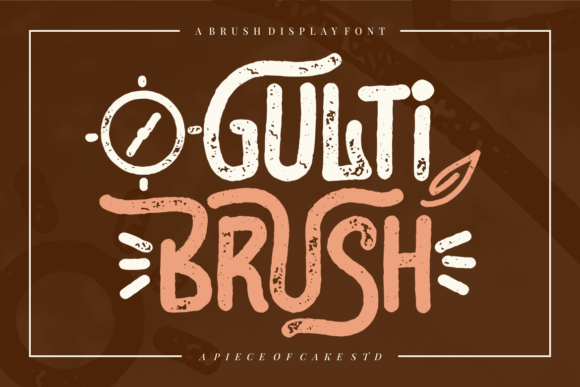
As someone who hand-presses labels, cuts vinyl stickers, designs printable wedding suites, and prints seasonal wall art for my Etsy shop, I know how much a font can make or break a product. Gulti Brush isn’t just another script—it’s a brush display font with genuine organic texture: subtle ink bleed, natural stroke variation, and that soft, hand-painted warmth you’d get from real calligraphy. It feels alive on the page—and on your products.
I reach for Gulti Brush when I need something expressive but still legible at small sizes—like 12pt on a kraft paper gift tag or 16pt on a Cricut-cut sticker. Its rounded terminals and open letterforms keep it readable even when scaled down or printed on textured cardstock. Unlike some overly ornate scripts, Gulti Brush avoids excessive swirls or fragile ligatures that vanish during vinyl cutting or laser printing. That makes it reliable across physical and digital workflows—from SVG files for Silhouette users to high-res PDFs for print-on-demand planners.
For handmade product packaging, Gulti Brush shines on candle labels, soap wraps, and herbal tea tags. I used it last month for a lavender honey line—pairing the font with a clean sans serif (like Montserrat Light) for ingredients and weight info. The contrast felt intentional, not chaotic. Customers noticed the difference: one left a review saying, “The label looked like it was made just for me—not mass-produced.” That’s the quiet power of thoughtful typography in craft branding.
It’s equally effective on greeting cards and invitations. I designed a set of birthday printable cards using Gulti Brush for names and headlines, then dropped in a simple serif (Lora Regular) for body text. The pairing balanced personality with clarity—no squinting needed, even for older recipients. For wedding stationery, I’ve used Gulti Brush on welcome signs and menu boards where its organic texture echoes hand-painted signage. It reads beautifully at 36pt on a 24x36” foam board, and holds up well in mockup previews shared with clients before printing.
Wall art and planner pages are where Gulti Brush really breathes. Its gentle irregularity adds visual rhythm to minimalist quotes (“Breathe,” “Grow Wild,” “Made With Love”) without overwhelming the layout. When printed on matte paper or cut as iron-on transfers for tote bags, the texture translates authentically—no flat, digitized look. I also use it for seasonal craft designs: think farmhouse-style Christmas ornaments with “Joy” in Gulti Brush, or Easter egg labels with “Freshly Dipped” in soft curves and warm contrast.
Readability matters most when precision is required. On small stickers (under 1” tall), I stick to short words—“Yes,” “Hello,” “New”—and avoid tight kerning adjustments that could cause cutting errors. For mugs and shirts, I test print at actual size first: Gulti Brush’s medium x-height and generous spacing mean it scales cleanly up to 80pt on ceramic sublimation or DTG apparel. Just avoid stacking more than three lines in this font—its strength is display, not paragraph text.
Gulti Brush comes as a single-weight display font, so it works best as a headline or accent typeface. There are no bold or italic variants—but that’s fine. Its charm lies in its consistency and character, not stylistic range. It includes standard OpenType features like discretionary ligatures and stylistic alternates (think swashed “g” or “y”), which add subtle flair when enabled in design software. File formats include OTF and TTF, fully compatible with Canva, Adobe Suite, Cricut Design Space, and Silhouette Studio. While it supports Latin-based languages (English, Spanish, French, German), double-check multilingual glyphs if you’re designing for broader markets.
Font pairing is where Gulti Brush becomes truly versatile. Try it with:
- A friendly sans serif (like Nunito or Poppins) for modern, approachable contrast—ideal for digital printables and social media graphics;
- A classic serif (Cormorant Garamond or Playfair Display) for elevated stationery and boutique packaging;
- A minimal monospace (JetBrains Mono Light) for unexpected, contemporary balance—great for tech-adjacent craft brands or maker-led workshops.
One practical note many makers overlook: licensing. Gulti Brush is a commercial font, meaning you’re fully covered to use it in physical products (stickers, mugs, fabric), digital downloads (PDF templates, SVG bundles), client work, and even merchandise sold through platforms like Etsy or Shopify. Just verify the license covers your specific use case—especially if you’re bundling fonts into editable Canva templates or reselling design assets. Most reputable sellers offer clear commercial terms, and Gulti Brush is no exception.
What sets Gulti Brush apart isn’t just how it looks—it’s how it behaves in the real world of making. It doesn’t demand perfect conditions to shine. It works on uncoated paper, survives vinyl weeding, reads clearly on Instagram story thumbnails, and retains its soul when resized for a tiny jar label or blown up for a storefront banner. That reliability, paired with its authentic handmade feel, makes it more than a display font—it’s a quiet collaborator in your creative process.
Whether you're pressing botanical labels, designing printable baby shower invites, cutting layered wood signs, or building a cohesive brand identity across product packaging and web graphics, Gulti Brush brings warmth without sacrificing professionalism. It reminds customers that something was made—not generated. And in today’s market, that distinction is worth every pixel.